
Some mornings, the guilt shows up before you do.
You open your eyes and your brain is already listing what you should be doing. Getting up earlier. Moving more. Being further along by now. Before your feet touch the floor, you feel behind.
So you stay in bed a little longer. Then a little longer. And the longer you stay, the heavier it gets.
I know that morning well. What I've learned is that the problem usually isn't laziness. It's a morning plan with only one setting: all of it. When "all of it" feels like too much, the only other option seems to be nothing.
There's a third option. It's one small rule I use almost every day. Before I get to it, it helps to understand why mornings fall apart in the first place.
Why The All-Or-Nothing Morning Keeps Winning
Most of us build our mornings like a test. There's a full routine, and you either pass or fail. Did the whole workout? Pass. Skipped it? Fail.
The trouble is that real life doesn't give you the same energy every day. Some mornings you wake up ready. Other mornings your body feels heavy, your mind feels foggy, and the full routine feels impossible.
When your plan only has one version, a hard morning means doing nothing at all.
The Guilt Loop
This is where it gets sticky. You skip the routine and feel bad about it. That bad feeling follows you into the day. The next morning, the routine feels even harder, because now it carries yesterday's guilt too.
Skip. Feel bad. Find it harder to start. Skip again.
That loop does more damage than any missed workout. It teaches you that mornings are where you let yourself down.
A Slow Start Is Still A Start
Here's the reframe that helped me: the goal of the morning isn't to be productive right away. It's to begin.
A slow start still counts as a start. A small start does too. Once you stop grading your mornings, they get a lot easier to show up for.
What I Used to Believe About Mornings (And What Changed)
A while back, I wrote a post called Morning Rituals for Your Success. At the time, I was stumbling through my mornings, and a mentor introduced me to the idea of morning rituals. They really did help. I wrote about them as the key to a better day.
I still believe mornings matter. What I didn't talk about back then were the days when the ritual felt like one more thing I was failing at.
Over time, my question changed. It stopped being "What's the perfect morning routine?" It became "What do I do when I don't want to start at all?"
That second question is what this post is about.
My Morning Before I Even Brush My Teeth
Here's what my full morning looks like. I'm not sharing it so you'll copy it. Seeing a real routine just makes it easier to build your own.
All of this happens before I brush my teeth or leave my room.
Make The Bed First
This is always step one. It takes a couple of minutes, and it gives me one finished thing right away. Before anything else has happened, something is already done.
That small win matters more than it sounds. It sets the tone.
A Little Stretching
Next, I stretch. Nothing fancy. I'm not trying to touch my toes or perform. I'm just letting my body know it's time to wake up.
10 Minutes Of Ashtanga Yoga
Then I do a short 10-minute Ashtanga practice. Ten minutes is enough to feel it, without being so long that I talk myself out of it.
Crunches And Sit-ups
After yoga, I do one set of 10 crunches and one set of 10 sit-ups. Short, simple, done.
Skipping In Place, Sometimes
On some mornings, I add skipping in place, with no rope, just the motion. It gets my heart rate up and wakes me up fast. I don't do it every day, and that's fine.
Why I Don't Leave My Room First
This part is on purpose. Once I leave my room, the day starts pulling at me. There's the kitchen, messages, other people's needs, a hundred small decisions.
Staying in my room keeps things simple. My order never changes: bed, stretch, yoga, crunches, sit-ups. There's nothing to decide except the next move.
Why I Started
I didn't start this routine because I had it all figured out. I started it after too many starts and stops. Every time I fell off, I landed in the same guilt loop. I felt like I wasn't measuring up to some ideal standard, one I didn't even realize I'd picked up along the way.
Then menopause added its own layer. My body wasn't working the way it used to, and I had to get to know how it works now. Between the physical changes and the emotional ups and downs that came with them, I needed something that would steady me, not one more thing to fall short of.
So I took a page from my old self. I went back to what I already knew how to do, but this time with more kindness toward myself and the stage of life I'm in.
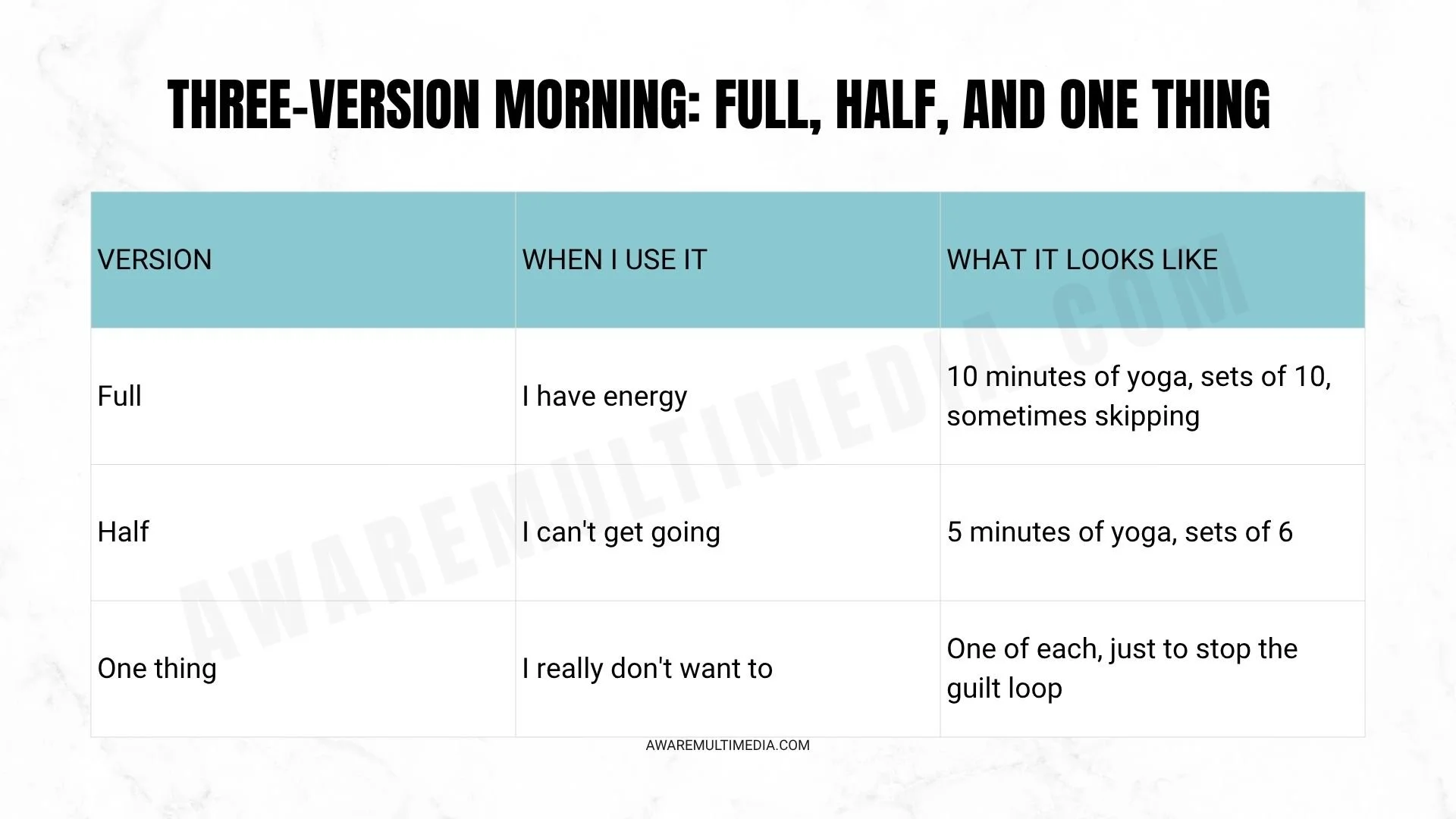
The Three-Version Morning: Full, Half, and One Thing
Here's where the routine becomes something that lasts. I don't have one morning routine. I have three versions of the same one.
Full: for mornings I have energy
10 minutes of yoga, sets of 10 sit-ups, crunches, and sometimes skipping in place.
Half: for mornings I can't get going
5 minutes of yoga and sets of 6 of the other movements.
One thing: for mornings I really don't want to
One of each move, just to stop the guilt loop.
Every version starts the same way: I make the bed. After that, the amounts change.
How To Choose Your Version Today
Choose based on today, not on yesterday's plan. Before you start, do a quick check:
Body: Does it feel ready, stiff, or heavy?
Mood: Are you calm, foggy, or low?
Time: Do you have room this morning, or is the day already rushing you?
If most answers lean "ready," go full. If they're mixed, go half. If everything feels heavy, go with one thing.
There's no wrong answer. You're not settling for less. You're choosing what fits today.
The "Just Do One Thing" Rule (And Why It Still Counts)
This is the rule that holds everything together.
On mornings when I absolutely don't want to do it at all, I do one thing of each. One stretch. One yoga pose. One crunch. One sit-up.
It sounds almost silly. But it works, and here's why.
What One Crunch Actually Does
One crunch won't change your fitness. That isn't its job. Its job is to keep the thread unbroken.
Habits don't usually die from one bad day. They die when one skipped day turns into five, and five turns into "I used to do that." Doing one thing keeps you on the inside of the habit, even on your worst mornings.
How It Quiets The Guilt Before It Builds
Remember the guilt loop? It needs a skipped day to keep going. The one-thing rule takes that away. You didn't skip. You did the routine in its smallest form, and you get to leave your room without that "I failed again" feeling.
When One Turns Into More, And When It Doesn't
Sometimes, once I've done one of each, I keep going. My body warms up and the resistance fades.
Other times, one is all I've got. And that's okay. The rule isn't a trick to get you to do more. One thing really does count, all by itself.
What Gets In The Way (And Small Fixes)
Even with three versions, some mornings still push back. Here's what most often gets in the way, and what helps.
Reaching For Your Phone First
Your phone is full of other people's demands. Open it first, and your morning belongs to them before it belongs to you.
Small fix: Keep your phone across the room, or face down until you've done at least your one thing.
A Stiff Body
At my age, my body doesn't always wake up when I do. Some mornings it needs more time.
Small fix: Sit at the edge of the bed for a minute before standing. Move slower than you think you need to. Stiffness is a reason to go gently, not a reason to skip.
No Real Space To Move
You don't need a home gym or a big room. You need about the space of a yoga mat.
Small fix: Choose moves that fit where you are. Stretching, seated movement and marching in place all work in a small space.
Mornings When You're Tired, Not Lazy
Sometimes the heaviness isn't about motivation. You're just tired, even after sleeping. If that sounds familiar, I wrote about it in my last post, How to Stop Feeling Tired All the Time (When Sleep Doesn't Fix It).
Small fix: On those days, go straight to the one-thing version. No debate.

How to Build Your Own Three Versions
Your routine doesn't have to look like mine. Here's how to build one that fits you.
Step 1: Pick An Anchor Habit.
This is the thing you do first, every single day, no matter which version you choose. For me, it's making the bed. For you, it might be opening the curtains or drinking a glass of water.
Step 2: Choose 2–3 Moves That Fit Your Body.
Pick things you can actually do. That might be stretching, a short walk around your home, seated arm and leg movements, or a few minutes of yoga.
Step 3: Set Your Three Amounts.
Write down what full, half and one thing look like for each move. For example:
Walking: 10 minutes / 5 minutes / to the door and back
Stretching: 5 stretches / 3 stretches / 1 stretch
Step 4: Write It Down Where You'll See It.
Put it on a sticky note by your bed or on your mirror. When your brain is foggy, you won't have to remember. You'll just read it.
Get It Ready The Night Before
Make your morning self's job easier. Before bed, lay out your mat. Put water beside your bed. Leave comfortable clothes within reach.
The fewer steps between waking up and starting, the more likely you are to start.
Small Things That Make Mornings Easier to Like
Habits stick better when they don't feel like punishment. A little enjoyment helps.
A few ideas:
Play one song you love while you make the bed
Open the curtains and let the light in right away
Use a favourite mug for your first drink
Notice one thing out the window before you start
These aren't rewards you have to earn by finishing your routine. Think of them as a bridge into the day. They make the start feel a little more like yours.
After The Routine: Make Your First Task Smaller
Once your routine is done, the rest of the day is waiting. The same idea still works here: make the first step smaller than the task.
Instead of "clean the kitchen," try "put three things away."
Instead of "catch up on everything," try "read one important message."
Instead of "get organized," try "clear one corner of the table."
Small first steps aren't a way of avoiding the big task. They're how you get into it without the dread.
Tracking Showing Up, Not Performance
When I started using versions, it helped to see my progress on paper. Not how many reps I did, just whether I showed up.
If that would help you too, the Energy Reset Ritual Kit™ includes a 5-day tracker you can use this way. Check off every morning you show up, including the one-thing days. Seeing a row of check marks, even small ones, makes it harder for the guilt loop to win.
Go At Your Body's Pace
A quick note before you try any of this. Move in ways that feel safe for your body. Stop if you feel pain, dizziness or unusual shortness of breath. If you have a health condition, a recent injury or balance concerns, check with a health professional before changing your routine.
Starting small is the whole point. There's no need to push.
Start With One Thing Tomorrow
You don't need more motivation to have a better morning. You need a morning that still counts when your motivation doesn't show up.
That's what the three versions and the one-thing rule give you. Full when you can. Half when you can't get going. One thing when you really don't want to. Every version is a real start.
Tonight, before bed, write down your one-thing version. Keep it simple. Put it where you'll see it when you wake up. Tomorrow, just do that, and notice how it feels to walk out of your room without the guilt.
What's the one thing that still counts tomorrow?
A Simple Morning Routine for Low-Energy Days
If you've searched for a morning routine for when you don't feel like getting up, you've probably found plenty of five-step plans and 5 a.m. wake-up challenges. Those can work when your energy is steady. They don't help much when your body feels heavy and your mind won't cooperate.
A simple morning routine for low energy works differently. Instead of one fixed plan, you keep three versions of the same habits, full, half and one thing, and choose the one that fits how you feel today. That makes it easier to stay consistent, because you never have to start over from zero.
These simple morning habits can help if you:
Keep starting and stopping morning routines
Feel guilty about mornings you "wasted"
Are dealing with body changes, including menopause, that affect your energy
Have a small space and limited time
Want a gentle morning routine that doesn't feel like a test
The key ideas to remember:
Start with an anchor habit, like making your bed, every day.
Match your routine to your energy instead of forcing the full version.
Use the one-thing rule on hard days so the habit stays unbroken.
Prepare the night before so starting takes fewer steps.
Track showing up, not performance.
How to start a morning routine you'll stick with comes down to this: make it small enough that you can do it on your worst day. Your best days will take care of themselves.